

Jews, Arabs, and the English-speaking World (2)
Posted by Terry Boardman on Nov 13, 2026 in east west issues, most recent, nwo | 0 commentsThis article was first published in New View magazine issue # 120 July -September 2026
under the title “Jews, Arabs, and the English-speaking World (2) -
Islam and Judaism, Britain and America: their Relation to the Incarnation of Ahriman”
In his book The Life and Times of Rudolf Steiner Vol. 2 (1961, English 2009), Emil Bock writes: “What is the secret of the great chaos and conflict in our age? In the end it is the fight between the spirit and the lack of spirit. The lack of spirit stems from the fact that the old kind of spirit came to an end long ago and changed into its opposite, and also because Christians have not yet brought the new kind of spirit into the world. So the terrible crisis approaches, which threatens Christianity as such. …Christians are no longer able to understand Christ the Son without new inspired thoughts entering from the Spirit. Dogma becomes blind, even blinder than it always was and is no longer in a position to impart knowledge about Christ.” Bock goes on to describe how the East and West of the Christian world separated over the period of the 4th to the 9th centuries through differing understandings of the nature of the spiritual world and of the Trinity. To this East-West split in the Christian world was added the very overt East-West division between the Christian and the Islamic worlds after the emergence of Islam in the 7th century. Since that time, two seemingly irreconcilable spiritual worldviews have faced each other, much as western capitalism and eastern communism seemed to confront each other in the 20th century, and still to an extent, in the 21st. But there was also another, less visible East-West divide within the European and Mediterranean regions after the 4th century, which has continued until today and which was the result of the Jewish diaspora in those regions. This article will consider these splits and divides in the light of the evolution of human consciousness over the past 3000 years in relation especially to the English-speaking world which currently dominates the period of history in which we find ourselves.
In this early third millennium, a major feature of the world situation, as it was in most of the 20th century, has been the rivalry and potential for conflict between East and West, and that means in this century between the USA and its allies, and China and its allies. But it’s also clear that, as in the 20th century, there is a continuing major trouble spot between those two blocs – in the middle of the world, in western Asia, the region that we in the West erroneously call the ‘Middle East’.1 This region has been a major trouble spot disturbing the peace of the modern world for three reasons: the collapse of the Ottoman empire, which controlled most of the region until 1918, and the weakening of the Islamic impulse which began in the 7th century; the discovery of oil in the region in the early 1900s, which prompted western Big Power interventions in the region in order to control that oil in their own interests and paradoxically led to the revival of the Islamic impulse; and the British government’s promise in the so-called “Balfour Declaration” to the Zionist organisation in Britain in November 1917 to support the establishment in Palestine of “a national home for the Jewish people”, which, after the end of the First World War, opened the gates to large-scale Jewish immigration, mostly from Europe, and eventually resulted in the foundation of the State of Israel in 1948 and the ongoing conflicts between this new Jewish State of Israel, the Muslim states in the region and western Christian states outside the region, notably the USA.
Britain and the Near East
Those three reasons had become facts because of the actions of the British government over the previous 20 years or so. In the 19th century, Britain had been well-disposed to Ottoman Turkey, the owner of most of the Middle East since the Middle Ages, because Britain, or rather, British elites in business, diplomacy, academia, the military and the Press, saw Turkey as a bulwark against the Power that the British Foreign Office had identified as Britain’s main enemy since the fall of Napoleon – Imperial Russia. British elites wanted to block Russia’s naval access to the Mediterranean Sea, the Red Sea, the Persian Gulf and the Indian Ocean, and also Russia’s overland routes into central southern Asia; in other words, they wanted to stop Russia getting anywhere near India – the goose that had been laying the golden eggs for the British Empire for nearly 200 years. The Royal Navy was, of course, a key part of this 100 year-long strategy, so when oil was discovered in what is now southwestern Iran and northern Iraq in the first decade of the 20th century, the British government were determined to gain control of the region’s oilfields, because they determined that oil, a natural resource which Britain did not possess, was a far superior means of powering warships than coal, of which Britain’s own supplies were plentiful. By the time the First World War broke out in 1914, Britain had largely, and conveniently, managed to gain control of Mesopotamian oil by putting pressure on Iran.
However, in the latter half of the 19th century, Darwinism, in the form of Social Darwinism – the doctrine of the ‘survival of the fittest’, an ideology which was transferred from the animal realm to human society – and its accompanying ideologies of ‘scientific racism’ and imperialism, had become the dominant modes of thinking among the late Victorian and Edwardian British elites (1870-1910). By 1900, Muslim Turkey was widely regarded as “the sick man of Europe”, terminally ill even, according to Social Darwinist thinking, and the British elites, led by the three-times Prime Minister Lord Salisbury (1830-1903), moved to ‘drop’ their old friendship with the Turks. This was noted by the new, international Zionist movement for Jewish nationalism, which had been established in the Swiss city of Basel in 1897 and which had decided, by the death of its founder, Theodor Herzl (1860-1904), that a future Jewish State must be founded in Palestine and nowhere else, and that the British government were the ones with the most power to secure it for them.2 The very able British Zionist, Chaim Weizmann (1874-1952), sounded out leading British politicians such as the Conservative Party leader Arthur Balfour (Lord Salisbury’s nephew), Lloyd George, the Liberal Party Chancellor of the Exchequer, and Herbert Samuel, Lloyd George’s fellow Liberal Cabinet colleague and the first practising Jewish Cabinet Minister in British history. These men, all very familiar with the Old Testament stories since childhood, were all sympathetic to the Zionist cause. Soon after war broke out between Britain and Turkey (Germany’s ally) in November 1914, Herbert Samuel had a long conversation with his Cabinet colleague, the Foreign Secretary, Sir Edward Grey, in which he suggested to Grey that this was the historic moment for Britain to facilitate the resettlement of the Jews in Palestine after 1900 years; Samuel later wrote that he told Grey that: “if a Jewish State were established in Palestine it might become the centre of a new culture. The Jewish brain is rather a remarkable thing, and under national [i.e. British – TB] auspices, the state might become a fountain of enlightenment and a source of a great literature and art and development of science”3 [emphasis – TB] – in other words, a settler state of mostly European Jews in the midst of the Muslim Middle East!

Herbert Samuel
Having pointed out to Grey that “it was probable that her [Turkey’s] empire would be broken up” by the war [this conversation took place on 9 November 1914, only 4 days after Britain and France declared war on Turkey!], Samuel went on: “I thought that British influence ought to play a considerable part in the formation of such a state, because the geographical situation of Palestine, and especially its proximity to Egypt [i.e. the Suez Canal and the Red Sea – TB] would render its goodwill to England a matter of importance to the British Empire. I suggested that the English and American Jews ought to take on leadership in such an enterprise […] Grey said that the idea had always had a strong sentimental attraction for him. The historical appeal was very strong. He was quite favourable to the proposal and would be prepared to work for it if the opportunity arose.”4 [emphasis - TB]
Grey and Lloyd George did what they could to help Samuel, but the Prime Minister, Herbert Asquith, was not well-disposed to the plan, so it did not go much further until December 1916 when Alfred, Lord Milner ousted Asquith in a political coup in order to forestall any peace deal with Germany and to continue the war until unconditional victory. Milner set up a 5-man War Cabinet with the compliant David Lloyd George as figurehead Prime Minister. Within a few months, the British army was set to invade Palestine from Egypt; Turkey’s military position was weakening. Seeing which way the political wind was blowing, Samuel had already contacted Milner in January 1916 and had put his plan for a Jewish state to him; Milner, whose allies and acolytes would be in control of the government by the end of the year, and whose right-hand man Leo Amery, was a pro-Zionist Jew, replied: “It contains suggestions which are new to me. Among the possibilities, which you review, the one which you yourself favour certainly appears to me the most attractive…” Milner, a London banker before he joined the Cabinet, and a man who had long had his finger on the pulse of the City, would remain a warm supporter of Zionism. Finally, with reference to Herbert Samuel, it should be mentioned that the Australian historian, Douglas Newton, has pointed out that in the two, absolutely crucial British Cabinet meetings in the morning and evening of Sunday 2nd August 1914 at which the decision was taken to enter the war, Samuel was the man who provided the key compromise proposals that kept the quarrelling pro- and antiwar factions in the Cabinet together and enabled Asquith’s Liberal Cabinet to declare war on Germany on 4 August.5 Without Samuel’s proposals, the consequent resignations threatened by several members, including the Foreign Secretary Grey and Asquith the Prime Minster (!) would have broken the Cabinet, and the government would have fallen. A general election would then have been necessary, which would have given the country the time to mount a populist antiwar campaign. As it was, there was no split, only two Ministers resigned, the Liberal government remained in office and bounced Parliament and the country into war within 2 days without even a proper debate in the House of Commons. But Britain’s declaration of war on Germany inevitably led to war between Britain and Germany’s allies, who included Turkey, the ‘owner’ of Palestine, and Britain’s possession of Egypt was right next door to Palestine. We see then, how the actions of two Jews (Weizmann and Samuel) played a crucial role in Britain’s establishment of a “national home” for the Jews in Palestine. We should also recall how Britain came to be in control of Egypt in the first place: in 1875, Britain’s first Prime Minister of Jewish heritage, the Conservative Benjamin Disraeli (1804-1881), rather than turn to the Bank of England, secured a loan from his friend, Britain’s premier banker Lionel de Rothschild, to buy from Egypt’s profligate ruler, the Khedive, the controlling shares in the Suez Canal, which had been built by the French six years earlier, in 1869. The Canal was deemed so crucial to British imperial interests in subsequent years that in 1882, under the government of the next Prime Minister, William Gladstone (1809-1898), a Liberal, Britain was so determined to ensure control of the Canal that it conquered Egypt and occupied it until 1922.
Three incarnations: Lucifer, Christ, Ahriman
The First World War, which signalled the end of Britain’s 200 years as a Great Power, also brought about the binary fact of the 20th century: the East-West struggle between capitalism and communism: the USA and the USSR. During the war Rudolf Steiner frequently spoke about long-range western plans, which stemmed from occult groups, to impose a “socialist experiment” on Russia for the purpose of weakening the country and of providing a negative demonstration of socialism to the working class in the West. The Bolshevik “Revolution” (Nov. 1917, more properly termed a coup) which brought the communists to power eventually succeeded in these two aims. Socialism had been an inevitable product of the industrial Revolution and of materialist thinking in the West, Steiner maintained, but western elites were determined it should not challenge their power in the West; they sought to push it over to the East where traditional, more collectivist social structures would be more amenable to it. Through financial assistance to the Bolsheviks and undermining the anti-Bolshevik White forces, Britain and America played the key roles in ensuring that the Bolsheviks succeeded in Russia6. As a result, Russia did not become a successful capitalist power that could challenge the West, which in 1914, it seemed like it might do, and after 70 years of communism, the Soviet economy collapsed in the late 1980s. Between 7 and 12 million died in the Russian Civil War 1917-1922. Evidence of the occult plans for a “socialist experiment” in Russia can be traced back to the 1890s; one of those who evidently knew of them was the British occultist C.G. Harrison, who spoke about this in a lecture in 1893.7 Steiner was made aware of C.G. Harrison already in 1897 by his well-connected Jewish friend, the Theosophist Friedrich Eckstein (1861-1939).
During the war, Steiner gave many lectures in which he spoke of the spiritual background to the war, but in the postwar chaos of 1919, he gave a series of 8 lectures about what could be called the ‘meta-background’ to the war and the modern age.8 In those lectures he spoke about the physical incarnations on earth of three great spiritual beings in human form, all of which incarnations occur only once in history. Two have already occurred and the last, he said would occur very soon. These three Beings were Lucifer, Christ, and Ahriman, who can be seen like three great pillars in the structure of the historical evolution of humanity, all occurring within a 5000 year period, ‘the very darkest period’, spiritually speaking, in the human story, when humanity falls to its lowest point, but at the same time, in that darkness, finds its freedom. The Being who Steiner calls Lucifer, who is not the same as the one referred to in dogmatic Christianity9 incarnated c.3000 BC in China. The fall into that ‘very darkest period’, which began c. 3000 BC, Steiner explained, had been accelerated by the incarnation of Lucifer, through a premature acquisition of the power of intellect, a power Lucifer had been the first on earth to manifest fully. This would lead, first in Asia, then in the Mediterranean world and the Near East, to the beginnings of science and materialistic thought. The descent of man, which Lucifer’s incarnation greatly intensified, had multifarious consequences affecting all aspects of human life and the human organism, as Steiner discussed throughout his work.
The Incarnation of the Logos, the Christ, in Jesus of Nazareth, occurred in order to begin the healing of humanity and the process, not of bringing humanity back to God and not of abandoning the earth but of enabling humanity to move forward to God, through the new qualities of individual love, repentance and forgiveness which Christ made possible, and through the gradual transformation of the earth. But while Lucifer sought to draw humanity to ‘himself’ in ‘his’ spiritual realm by trying to separate us from the beneficent spiritual powers, and above all from the Christ, and was the main opponent of human development in the pre-Christian period, in the post-Christ Incarnation period of human development in the last 2000 years we have become increasingly susceptible to the deceptive wiles of Ahriman who, contrary to Lucifer seeks to bind our thinking to what is entirely material and to convince us that there is no spiritual world. Through the aid of Christ, we survived the effects of Lucifer’s incarnation in China 5000 years ago which, Steiner pointed out, influenced the whole of Eurasia as far west as Greece.10
But we now have to face the coming incarnation of Ahriman, the inspirer of materialism, aided by the new individual capacities we have gained over the past 2000 years, both collectively, as the human race, and as individuals through the incarnations we ourselves have personally experienced since the Incarnation of Christ, and aided also by the Christ Who, Steiner began to reveal from 1910, is now active in the etheric life sphere of the earth borne by an angel just as He was borne by a human being 2000 years ago. He has been, since the 1930s, accessible to us there in the realm of the angels.11
The build-up of the ‘atmosphere’ surrounding Ahriman’s incarnation has been accelerating not only materialistic thought in general across all social fields for the past 400 years, beginning in theology and philosophy, and going on to more modern phenomena such as political totalitarianism, systems thinking, super-corporatism and surveillance but particularly the ever-intensifying acceleration of technology, notably in electronics, robotics, computing, the Internet, biogenetics and more recently, AI.

It is not difficult to see that over the past 250 years there has been a drive within technological development to replicate the human organism, beginning with muscle power (the first Industrial Revolution, steam power, electro-magnetic machines), and going on to the human senses and now human consciousness and eventually seeking to replace human consciousness and the human being altogether.
The Islamic impulse, Britain and America, and the incarnation of Ahriman
It took 2000 years of preparation of the Hebrew, Israelite and later, Jewish people12
the head of Ahriman – sculpted by R. Steiner
to produce, through genetic development and through the strict discipline of the people by their kings, prophets, judges and priests, the organism required to serve as the vehicle for the Incarnation of the Logos in Christ Jesus. No doubt a long period of preparation had been necessary for the incarnation of the Lucifer Being
in China, but we have no historical data for that preparation. What about the preparation of the incarnation of Ahriman, as indicated bySteiner, who said the incarnation would occur “before only a part of the third millennium of the post-Christian era has elapsed”13 and it would happen “in the West”? When did the preparation for this event begin? Looking at all the developments “in the West”, from Rome to California over the last 1500 years, and especially since the late 18th century – notably in the areas of materialist thought and scientific and technological development, and considering the various things Steiner indicated about the ahrimanic incarnation in the eight lectures in 1919 mentioned earlier – I think we can say with some confidence that the cultural stage for the incarnation of Ahriman is the United States of America14, and that this new political entity was essentially ‘birthed’ out of the island of Britain. Individuals from some other European countries played a part too, of course, such as Columbus, Lafayette and Napoleon15, but the 13 colonies of the USA, with their differing northern and southern proclivities, clearly emerged from Britain, and particularly from England.
The rise of England to world power began in the late 17th century, after England had integrated into itself, since the Norman Conquest (1066) and the Crusades (11/12th cents.), many cultural and scientific achievements of the Arab Muslim culture of the Near East, which arguably culminated in the life of Sir Francis Bacon (1561-1626), renowned lawyer under Queen Elizabeth I, Lord Chancellor under King James I, politician and scientist (or ‘natural philosopher’, as scientists were known in those days).
Sir Francis Bacon, philosopher, Attorney General (1613), Lord High Chancellor of England (1618),
created Baron Bacon of Verulam (St Albans) 1618 and Viscount St Alban 1621
Bacon was the instigator of the inductive scientific method and experimental science in general and author of The Great Instauration (1620) and The New Atlantis (1626); in 1660 he was posthumously made the patron of the newly founded Royal Society – England’s new, elite-fostered organisation for the promotion of science. Rudolf Steiner, in his karmic research in 1924, had much to say about Bacon, including that Bacon’s previous incarnation had been as the famous caliph of Baghdad, Harun al-Rashid (c.763-809)16, who created a brilliant Court culture around him in Baghdad in the late 8th century, and that, having been unable to accept Christ in the spiritual world, he had reincarnated into England in order to implant powerful ahrimanic impulses into British culture.17 “Harun al-Rashid could not disseminate from London, from England, a form of culture strictly aligned with Arabism…this soul was obliged to make use of the form of Arabism that was possible in the west. But the fundamental trend and tendency of what Bacon poured into European thinking is the old Arabism in a new form. And so Arabism lives in the scientific thinking of today, because Francis Bacon was the reincarnated Harun al-Rashid.”18
The ground had been prepared for Bacon in England by such thinkers as the statesman, philosopher, theologian, scientist and Bishop of Lincoln, Robert Grosseteste (1168/70-1253) who the Australian historian of science A.C. Crombie called “the real founder of the tradition of scientific thought in medieval Oxford and in some ways, of the modern English intellectual tradition”, and Grosseteste’s most famous ‘pupil’, Roger Bacon (c. 1219/20 – c. 1292), polymath and empiricist – both men were Franciscans. Grosseteste (whose name means literally ‘big head’!) followed Aristotle’s view of the dual path of scientific reasoning: generalising from particulars to universal laws, and then from universal laws to the prediction of particulars. Roger Bacon followed Grosseteste’s lead by adding to observations by Aristotle the empirical method of the Arab (or Persian) Abu Ali Ibn al-Haytham (Lat. Alhazen: c. 965 – c. 1040), who has been called “the father of modern optics”. Although both Grosseteste and Bacon were men of their time in many ways, they were also far ahead of most contemporaries in their scientific understanding and both were especially focused on the science of optics. In the medieval struggle of the Scholastic philosophers, between the Nominalists, who denied the real (i.e. spiritual) existence of universal general concepts and the Realists, who asserted the existence of such concepts, most Franciscans inclined to Nominalism, while most Dominicans upheld Realism. William of Ockham (c. 1287 – 1347), a philosopher known for ‘Occam’s Razor’ was another such Franciscan. In England, the Nominalists had the upper hand. Their victory has been seen by many, Steiner included, as a curtain-raiser for the age of materialistic natural science.
Another factor that prepared the ground for Francis Bacon (Harun al-Rashid) was that English law in the late Middle Ages was already deviating from continental (Roman) law, because English law came to be based not on general principles but on case law – the accumulation of individual cases with which judges were expected to be familiar, whereas Roman law proceeded from general principles against which individual cases were compared. This led on to a preference in academic circles on the continent for deductive reasoning from the general to the particular, but in England – and especially after Francis Bacon who, it should not be forgotten, was one of the most famous lawyers in the land (!) - to the preference for inductive reasoning, from the particular to the general. After Bacon, this became the basis of the empirical natural scientific method.
Steiner explained in various places that the doctrine of the Trinity is what “makes it possible for the impulse of freedom to have its place in the evolution of Christianity”. Steiner saw the Father God (in Judaism, Islam and Christianity) as responsible for all the forces of the powers of Nature, which include the compulsive forces of physical reproduction and physical germination. These intrinsically have nothing to do with human freedom; they exist for the purposes of human physical existence on the physical plane “….it is the essential characteristic of a Moon religion, a religion like that of the ancient Hebrews [and also of Islam - TB], in which the Father Principle is predominant, always to attach value in the human being only to what has been bestowed upon him through the forces of the Father God, through the Moon forces….The Father God rules over whatever is predetermined in man because it is born with him and works in him as the forces of Nature. It is upon this principle that the Hebrew religion is based. But by the side of it, Christianity places the power of the Son which during the course of man’s life draws into his soul as a creative force, is freeing and enables him to be reborn, realising that in his earthly life he can become something that was not predetermined by the Moon forces at birth… Mohammedanism [i.e. Islam – TB] set its face against this impulse …It [Islam] is a retrogression to the pre-Christian principle, but clothed in a new form, as was inevitable six hundred years after the founding of Christianity. … The God of Nature, the Father God [some today would no doubt prefer to say the Mother God or Goddess! – TB] – not a God of freedom by whom men are led on to freedom – was proclaimed as the one and only God”19 by Mohammed.
In the 6th century before Christ, the kingdom of Judah was destroyed along with the Temple of Solomon in Jerusalem, many of its people were taken captive to Babylon (586 BC) but were allowed to return in 539 by the Iranian king Cyrus who had conquered Babylon in the interim. Many opted to remain in Babylon, but those who returned then rebuilt the Temple in Jerusalem, and a new chapter in the story of Israel began, in which many parts of the Bible were written down for the first time or revised. This is known as the Second Temple Period and lasted until the second temple was destroyed by the Romans in 70 AD following the Jews’ great rebellion, which began 33 years after the Crucifixion of Christ. But in essence, the religion remained the same after the Jews returned from Babylon. It was a religion for a people, an ethnic group, based on blood and soil and sealed with physical seals (circumcision and physical descent from the mother); it was not a religion for all individual human beings, and it was and is circumscribed by some 613 rules and the opinions of many religious scholars set down in the many volumes of the Talmud as to what is correct behaviour. Islam, which can be said to have begun with the birth of Mohammed in the 6th century after Christ (570). By contrast, Islam was and is a religion for all human beings. In this sense, Islam is similar to Christianity, and Islam reveres Jesus, whom it regards as a prophet who will return in the Last Days , and also reveres his mother Mary, whereas Judaism reviles them both in the Talmud.
In history therefore, Christianity appeared between the older and the newer Moon religions of Judaism and Islam: “it is important to realise that the Christ Impulse …was actually a kind of revival of Mosaic monotheism. This idea of the One God, however, included a food deal derived from other sources, for instance from the Egyptian and Chaldean religions, which had yielded very exact knowledge of the connections of the happenings in the starry heavens with earthly events […] the thoughts and ideas current among the Egyptians, Chaldeans, Babylonians and Assyrians appear again in the religion of Mohammed, but pervaded by the One God Yahweh.”20 The Arab armies carried not only the Qur’an over to Europe but also numerous aspects of Near Eastern culture, including Egyptian and Jewish healing arts, Chaldean astronomy, and Persian architecture – all of which, Steiner points out, stemmed from clairvoyance and the ancient Mysteries but can be “found in the Arabism of Mohammed in an intellectualised and individualised form…denuded of their visionary and pictorial content and recast into abstract forms.” “Whereas Christianity brought an impulse connected essentially with the life of the soul, the greatest impulse given to the human intellect [after the Incarnation of Christ – TB] was brought by the Arabians.[…] There could have been no Kepler, no Galileo, without the impulses brought by Arabism into Europe. For the old [pre-Christian] mode of thinking appears again, but now denuded of its ancient clairvoyance… We can therefore say that the Sun and Moon symbols merged into each other from the 6th/7th centuries up to the 12/13th centuries – – again a period of some 600 years.”21 This science which was based on ancient Mystery knowledge was brought to Europe in a more intellectualised form through war and through trade with the Arabs – but also through the culture of the Jews and the Near Eastern elements they brought with them when they moved to Iberia, Italy and Central Europe – and all this ‘science’ eventually had its greatest impact in England in the 17th century, with men such as Francis Bacon, Isaac Newton, and Christopher Wren and thus played its part in the preparation for the incarnation of Ahriman in the English-speaking world.
There is one other important consequence of Islamic thought that entered into English culture that deserves to be mentioned. Steiner often spoke of the great intellectual struggle that was waged between the leading minds of the Dominican Order in the 13th century who believed in the intelligence of individual human beings – a more Christian viewpoint – and those, mostly Franciscans, who supported the philosophical ideas that had come from the Islamic world – mostly interpretations of and commentaries on pre-Islamic, Greek philosophy - the ideas of from such men as Ibn Rushd (1126-1198) (he became known in the West as Averroes as “the father of Rationalism”), who argued for the unity of the intellect and, following Aristotle, that there was no personal intellect or intelligence but rather, a single pan-intelligence which human heads merely reflected.

Ibn Rushd (Averroes)
Steiner shows22 how this was once true, before the Incarnation of Christ, but that since then, evolution has taken the course of increasing individualisation and individual freedom; human beings have become increasingly responsible for their own thinking and intelligence. The Averroist idea of the pan-intelligence influenced the growth of the notion, especially in England, that science, or intelligence, is not the creation of the individual human being, whose thoughts are only subjective and do not relate to objective truth, and that the internal world of the human being should be separate from ‘science’. This idea therefore buttressed the materialistic view of the human being and tended to support the materialistic understanding of Nature.

Ray Kurzweil
Over the past century, in such ideas as the “world brain” (H.G. Wells), the “global brain” (Peter Russell), “the hive mind” (Kevin Kelly), the “Singularity” (Ray Kurzweil) and “Neuralink” (Elon Musk) the idea of the Averroist pan-intelligence has resurfaced in various ways in the English-speaking world. These ideas can be said to serve and reflect the incarnation of Ahriman by threatening the individual thinking capacity of the human being. “It is necessary to ask oneself: what is the most necessary faculty of the human soul in our epoch? Intellectuality”. Again and again, Steiner spoke about how the future of humanity depends on our ability to spiritualise this intellectuality, and all his work, from The Philosophy of Freedom (1894) to his final Anthroposophical Leading Thoughts (1925) was dedicated to revealing how that can be done.
From Puritanism to Unitarian Universalism
Francis Bacon was one of those at Court who, together with others, applied for and received a charter from King James I to plant a colony in North America, in Newfoundland; the colony began in 1610.23 This was the beginning of English colonies in the north of North America, which later led to New England and the first intellectual powerhouse of the North American colonies and the USA (Harvard, Yale, MIT etc).
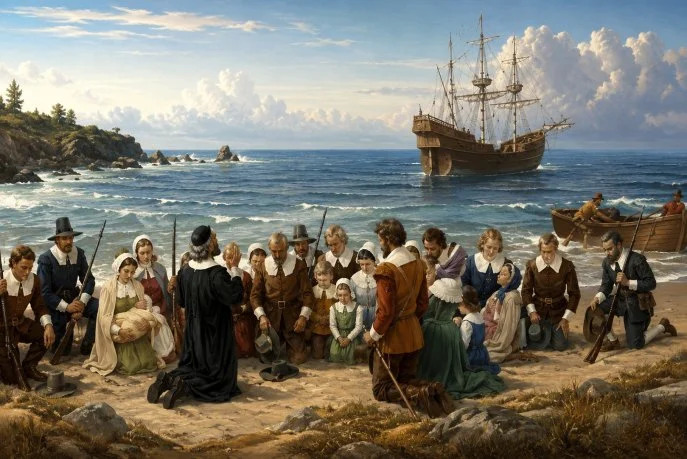
Puritans arrive in “New England” (1620)
Although an Anglican, Bacon was sympathetic to Puritanism, which in its theology and practices had much in common with Islam and also with Judaism. Ever since the Hussite revolution in Bohemia against the Papacy in the early 15th century when its leader Jan Hus told his followers in the Hussites’ Bethlehem Chapel that “the time has come for us, just as it did for Moses in the Old Testament, to take up our swords and defend the law of God”, Protestants had framed their revolutionary opposition, first to the Papacy and later to Protestant State churches, in Old Testament contexts, seeing their community as “an holy nation” needing to “fight Edom”, “destroy Amalek”, “depart from Egypt” or “seek the Promised Land” and comparing their leaders to Moses or Joshua. The emphasis was on the ‘Primitive Church’ of the time of Christ and Jewish models were sought everywhere. As in Islam, images were condemned and iconography was kept abstract. The call was for a simpler religion taught in the people’s own language, like Hebrew and Arabic; the text of the Bible became increasingly sacrosanct until in the 16th century, sola scriptura (only the Bible) became the watchword among some Protestants. The Hussite revolution had been sparked by the radical ideas of the English preacher at Oxford University, John Wycliffe (1328-1384) after Princess Anne of Bohemia had married King Richard II (1377-1399) of England.
For the next 300 years in Europe a fervent Protestant spirit infused European Christendom and especially in its more radical manifestations there was often something about it that was redolent of Jewish or Muslim religiosity in the simplicity and severity of outward religious observance, the manners and dress, the reverence for the Holy Book. One can wonder whether it was not only isolated individuals such as Francis Bacon and Amos Comenius24 who were incarnating in Europe as radical Protestants during those centuries from previous lives in the Near East, but in fact hundreds and thousands of Jewish or Muslim souls. One sees that the theologically more radical streams in Protestantism, such as Deism and Unitarianism, came to reject the doctrine of the Trinity and that these streams became especially widespread in Britain and America eventually. Deism, which acknowledges only a single, transcendent, abstract deity separate from the world, became the basis for the religiosity of many Freemasons. Deist influence was especially common in Freemasonry, which itself emerged in Britain in the 17th century in an age of radical religiosity and spread from the British isles across Europe and the world. Freemasonry can be described as a particularly British form of ‘religious’ activity, but it was and is based to a large extent on Jewish and older Babylonian Mystery culture. In America, some streams of Unitarianism, which developed from the original Pilgrims and Congregationalists of New England, went so far in the 19th and 20th centuries as to abandon Christian doctrine altogether and morphed into what is called Unitarian Universalism, a form of loose community life in which all faiths or none are accepted. Since 1960, Unitarian Universalists have subscribed to a set of 7 abstract and humanistic “shared values”. What thus began in the 16th century as a desire to return to the pure Christianity, the ‘Primitive Church’, of the age of Christ and His disciples has since metamorphosed in the English-speaking world into an abstract and sentimental humanism that has essentially dispensed with Christianity. Some would say that in Unitarian Universalism, the Christian roots of western culture have been set aside in the name of:
1. The inherent worth and dignity of every person;
2. Justice, equity and compassion in human relations;
3. Acceptance of one another and encouragement to spiritual growth in our congregations;
4. A free and responsible search for truth and meaning;
5. The right of conscience and the use of the democratic process within our congregations and in society at large;
6. The goal of world community with peace, liberty, and justice for all;
7. Respect for the interdependent web of all existence of which we are a part.25
Others would assert that what they feel to be the true spirit of Christianity informs these 7 principles. For myself, of the two commandments that Christ said (Matt 22: 37-39) were the most important, I feel that something of the second – “love thy neighbour as thyself” – can be felt in these principles, but the first, which Christ called “the first and great commandment” – “love the Lord thy God with all thy heart, and with all thy soul, and with all thy thinking” (or contemplation)26 - is absent from this list. The Unitarian Universalist principles, which countless people in the West today who regard themselves as progressive and liberal-minded would no doubt agree with, even if they have never heard of Unitarian Universalism, are therefore exposed to materialism; they do not orient one to God and the spiritual world but rather, to other human beings and the world of physical nature. Unitarian Universalism, albeit in an almost atheistic way, exemplifies something that is a descendant of the overarching, all-embracing spirit of the religions of the Near East that are rooted in a transcendent ‘Father-God’ and which in the modern world, has contributed to the emergence of support of many for the universalist conceptions of world government via the United Nations, the World Health Organisation and other such globalist structures – great comprehensive ‘pseudo-parental’ beings that will look after us if we follow their ‘guidelines’ and ‘rules’ for our ‘sustainable development’, their many International festive Days celebrating this and that.
***
From the 12th century (the Crusades) to the 17th century then, influences from the Near East had a significant impact on life and thought in Britain, including through the reincarnation of souls from the Muslim world, such as Francis Bacon, who, according to Steiner’s reincarnation research, had been the powerful Caliph Harun al-Rashid, but there was no Muslim invasion of Britain and no Muslim immigration. This changed in the 20th century, when large-scale Muslim immigration, much of it from Pakistan, but also from other countries, began and has continued while, at the same time, the traditional Christianity of the churches has markedly declined; many churches have even been converted into mosques. Islam is today the second-largest religion in Britain, at 6% of the total population (2021 census). The character of several large cities in Britain (e.g. London, Birmingham, Leicester, Bradford) has been changed by this Muslim immigration. Estimates as to future UK Muslim population growth vary between 6.56 million (12.7% of the population) and 13.48 million (17.2%) by 2050.27 What is likely is that by 2050 and certainly by 2100 Britain will look and feel very different from what it was in the 1950s.
The Jews and the Anglosphere
Meanwhile, Jewish influences on life in Britain which came through Christianity, especially via the stories and strictures of the Old Testament, were numerous until the mid-17th century, but there were very few Jews in Britain before 1066, and officially, none between 1290 and 1655, when Oliver Cromwell readmitted them. Since then, the influence and power of Jews in Britain has increased steadily to the point where, although they account for only some 277,600 (0.4%) of the total population (2021 census), that influence and power far outweighs their numbers. The same is true in the USA, even more so, when in recent years many Americans have come to question whether US foreign policy has not in fact been largely determined by Israel’s interests since 9/11 rather than the interests of the people of the USA. Keeping in mind the thesis advanced earlier in this article – that influences from ‘the semitic world’, the world of both Jews and Arabs, of Judaism and Islam, have played a significant part in the preparation in the English-speaking world for the incarnation of Ahriman, the following facts are of significance for the English-speaking world: William I’s invasion of England in 1066 was part-financed by Jewish merchants in Rouen28; Christopher Columbus’ epoch-making expedition to cross the Atlantic in 1492 was promoted and financed by two figures of Jewish heritage: the Chancellor Luis de Santángel and the Royal Treasurer Gabriel Sanchez29; the invasion of England (from the Netherlands) by Prince William of Orange in 1688 (later he became King William III of Great Britain 1689-1702) was financed by a loan of 2 million crowns from the Dutch Sephardic (i.e. Iberian) Jewish banker Francisco Lopes Suasso (below) and assisted by Sephardic Jewish weapons contractors Solomon de Medina, Jacob Pereira, Moses Machado and Jeronimo Nunes da Costa.

Francisco Lopes Suasso, portrait by Nicolaes Maes
“Anglo-Dutch Jewish military contractors remained William’s key suppliers during James II’s invasion of Ireland and the start of the Boyne Campaign in spring 1690”30, the success of which ensured that Ireland remained under the control of William’s new Anglo-Dutch Protestant Establishment. “The Sephardi Jewish community was the backbone” of William’s war against Louis XIV of France. “While they did not really fight in the armies themselves, their funds & supplies were essential to keeping William’s war effort going. It is very likely that without the help of the Sephardi Jews, William’s campaign would have failed. … Sephardi Jews quickly gained the main shares in the Bank [of England, founded 1694]. Solomon de Medina was the first Jew [to be knighted, in 1700 – TB] and to subscribe to the Bank’s stocks after its books had been opened, and his stock went from £1,000 in 1694 to £28,000 in 1701. Between 1695 and 1712 the Sephardi Jew Peter Henriquez Jr. was often the largest holder in the bank, and by this final year his holdings amounted to £50,189. In 1701, Jews made up more than 10% of the group owning the minimum amount of stock to qualify for governorship of the Bank. Jews also dominated the London Stock exchange by the end of the century and were responsible for its growth.”31
The so-called “Glorious Revolution” of 1688 marked the beginning of Britain’s rise to world power in the outer material sense and as such, was a most significant forward step for the preparations for Ahriman’s incarnation. To Britain’s native wealth, from such resources as sheep, coal and iron, and to its natives’ national characteristics of acquisitiveness, intrepid adventurousness, competitiveness and aggressiveness – qualities that had developed since the time of the Vikings and the Normans – was now added the financial and commercial acumen that the Jews brought; the combination led to the expansion of the British Empire in the 18th century. “William of Orange’s Glorious Revolution was financed by Jews, and they were crucial to its success…. This shows how important an organized minority is for a revolution. Although the Jewish community of Holland was small, their money financed a regime change in England. … Puritans saw themselves as a chosen people similarly to the Jews and saw commerce as important. Calvinism also had a philosemitic theology.”32 With the “Glorious Revolution”, any remaining monarchical pretensions to a divine right of kings were removed. Real power was transferred from monarchy to the oligarchies of the grand landed aristocrats in their country estates and the rich merchants and bankers of the City of London. “The decline of the Dutch Empire followed the Glorious Revolution, as Britain began to assert itself as a colonial power on the world stage. The Jews would continue to play crucial roles in the trade sectors of this empire, and England’s Jewish community would grow to become one of the most powerful and influential in the world.”33 That power and influence then gradually spread to Britain’s N.American colonies and thus to the new American Republic after 1776. The Polish-born Jew, Haym Salomon (1740 – 1785), was a Jewish broker and financier who played a key role in the success of the American Revolutionary forces during the American War of Independence and especially in securing the final victory in 1781. He collaborated closely with the American Superintendent of Finance Robert Morris Jr., who was known as the “Financier of the Revolution”.
In Britain, Sephardic Jews of Iberian origin had steadily improved their community’s position, notably through trade and finance, by the end of the 18th century, and Nathan Mayer Rothschild (1777 – 1836), an Ashkenazi Jew (i.e. of Central European origin) who had moved to Britain from Frankfurt at the age of 21 in 1798, eventually became the leading British banker.

Nathan Mayer Rothschild
He joined the Emulation Lodge No. 21 of the Premier Grand Lodge of England in 1802, began to trade in gold bullion seven years later, and from 1811 became a major supplier of finance to the British Army through his personal connection with the Commissary-General, John Charles Herries. It is well-known that Rothschild gold financed the Allies’ victorious campaigns against Napoleon 1813-15, including the Waterloo campaign in 1815, and that the Rothschilds were financial advisers and postal couriers to Queen Victoria and her husband Prince Albert, as they had been to his Saxe-Coburg dynasty in Germany34. That victory at Waterloo raised the curtain on Britain’s subsequent 100 year-long pre-eminence in world affairs, which was built on British technological and financial abilities, the latter of which were dominated by Jewish financial houses; indeed, without Jewish banking, loans and investment, the British Empire in the 19th century would simply not have been possible. A most notable event in British imperial history was Britain’s first Jewish Prime Minister, Benjamin Disraeli using his close connections to the Rothschilds to secure a loan from them of £4 million (a huge sum at the time) for the UK government which enabled it to purchase 44% of the shares in the Suez Canal Company in 1875. Britain’s financial interests in Egypt from then on eventually led to a violent British invasion of Egypt in 1882 and subsequent occupation of the country until 1922. This “protectorate” and the British concern to keep control of the Suez Canal was a major factor in the issuance of the infamous Balfour Declaration to the Zionist movement, led in Britain by Lord Walter Rothschild, in November 1917.
Jews in finance and politics in the USA
Meanwhile, in the USA, by 1900, Jewish banking interests had grown to rival those of the American white Anglo-Saxon Protestant (“WASP”) banks, notably in New York, which had seen a great influx of Jewish immigration since the early 1880s. Two of the most powerful Jewish bankers were Jacob Schiff (1847-1920) of Kuhn, Loeb & Co., and Paul Warburg, of the Warburg banking dynasty. Schiff arrived in America after the Civil War and became the leading Jewish banker in the USA until he died, involving himself in various aspects of Jewish life in America and abroad and carrying on a vendetta against the Czarist Russian government, financing Japan’s war against Russia in 1904-05 (which, incidentally, also served Anglo-American commercial interests in the Far East against growing Russian penetration of China) and funding political opposition to the Czars until the Bolshevik takeover in 1917. Paul Warburg (1868 –1932) of the M.M. Warburg bank of Hamburg, Germany (the family’s origins were in Venice) moved to the USA in 1902, having married the daughter of banker Solomon Loeb, of the Kuhn, Loeb & Co. investment bank. His brother Felix Warburg married the daughter of Jacob Schiff. Paul Warburg became a partner at Kuhn, Loeb & Co., working under Jacob Schiff.

Paul Warburg
Warburg was only naturalised a US citizen in 1911, but in 1912-1913 played a major role in the establishment of the US Federal Reserve system. As soon as he arrived in America, he had pressed for a US central bank on European lines, something that had long been strongly resisted in the USA since the time of Thomas Jefferson as dangerous to the liberties of the American people. At least three times since Jefferson’s era, leading bankers had tried and failed to establish a permanent central bank; only 11 years after Paul Warburg’s arrival in the US, they finally succeeded after conducting a devious political campaign carried on with the assistance of Jewish-owned newspapers such as the New York Times and compliant politicians such as Senator Nelson Aldrich and Woodrow Wilson of Princeton University; Wilson was manoeuvred into the White House by the bankers and their allies in politics and the media in order to facilitate the passing of the Federal Reserve Act in 1913. Paul Warburg had been a key figure in the highly secretive meeting of bankers and politicians at Jekyll Island, Georgia in 191035 which planned the institution of a central bank in the USA. Professor Edwin Seligman, who was head of the Department of Economics at Columbia University, himself Jewish and a member of the international banking family of J. & W. Seligman, wrote of the Federal Reserve Act (1913): “In its fundamental features the Federal Reserve Act is the work of Mr. Warburg more than any other man in the country…. The existence of a Federal Reserve Board creates, in everything but in name, a real central bank…”36
Jewish financial power in the USA has grown even greater since then. Of the 8 Chairs of the Board of Governors of the Federal Reserve System since 1970, for example, 5 have been Jewish, including the current Chair, Kevin Warsh, appointed this year by President Trump, and one of the non-Jewish Chairs (William Miller, 1978-79) was only Chair for 1 year and 151 days. In 2020, Jews made up only 2.4% (5.8 million) of the US population of 349 million.37 The economic crash of 2008, overseen by the Federal Reserve Board Chair Ben Bernanke (Jewish), who followed 18 years of the Chairmanship of Alan Greenspan (Jewish), was prompted by the fall of the (Jewish) Lehman Brothers investment bank, the 4th largest in the USA at the time, after Goldman Sachs (Jewish), Morgan Stanley and Merrill Lynch. Today, the world’s largest asset manager, or multinational investment company, with $US12.5 trillion in assets (2025), is BlackRock, led by Larry Fink (Jewish), who is also Chairman of the World Economic Forum (Davos, Switzerland). BlackRock was founded in 1988 as an offshoot from the private equity firm Blackstone Group, which was founded in 1985 by Stephen Schwarzman (Jewish) and Peter Peterson, who both used to work for Lehman Brothers.* The other 3 leading financial firms in the USA – Vanguard, State Street, and Fidelity - are not Jewish-controlled, but several of the titans of the modern US tech industries are: Google (Ruth Porat, Anat Ashkenaz), Meta (Mark Zuckerberg), Open AI (Sam Altman), Oracle (Larry Ellison).
In US politics, there are Jewish lobby groups such as American Israel Public Action Committee (AIPAC), Zionist Organisation of America (ZOA), Anto-Defamation League (ADL), the Israel Policy Forum (IPF), the American Jewish Committee (AJC), the Religious Action Center of Reform Judaism, Americans for a Safe Israel, American Friends of Likud, Mercaz-USA, Hadassah, and last but not least, the non-Jewish, Christian evangelical group, Christians United for Israel (CUFI), led by pastor John Hagee (10 million members). These groups have a considerable influence on US foreign policy.38

Thomas Massie
In May 2026, Thomas Massie of Kentucky, the single US Congressman in the US Congress this year who dared to criticise American military and financial support for Israel and Israel’s genocidal actions in Gaza became the latest in a string of US Congressmen and women39, stretching back decades, who have been critical of Israel or US actions favourable to Israel and who have been defeated by the well-oiled, well-financed and orchestrated advertising campaigns of Zionist or pro-Zionist lobby groups. Massie was defeated in the most expensive local election in US history in which $32 million were spent combating him – just one man! – , $9 million of which was from Jewish lobby groups. $5 million of that $9 million was spent by the Republican Jewish Coalition (RJC), whose CEO Matt Brooks, openly celebrated the defeat of Thomas Massie when speaking at the RJC 250 Gala in New York City on 31 May and justified the money spent, saying, with typical American Jewish chutzpah: “When someone repeatedly undermines support for Israel, traffics in isolationism at a moment of global danger and refuses to stand with the Jewish state when it matters most [i.e. at a time of genocide committed by that Jewish state against civilians in Gaza! – TB], there has [sic] to be consequences!”40 Amir Ohana, the Speaker of the Israeli parliament, the Knesset, spoke at the same gala: “America is a nation whose leadership still lives by the truth its founders knew, that freedom endures by virtue of three simple words: ‘Fight, fight, fight,’”. This echoed what Donald Trump said immediately after the attempt to assassinate him on 13 July 2024. Ofir Akunis, Israeli consulate general in New York, told those at the gala that he applauded the RJC for “making sure that the elected officials in office represent our collective values and that the U.S.-Israel relationship stays at a high priority.” At the same RJC gala, US Congressman Mike Lawler (Republican, New York), “who represents the most heavily-populated Jewish congressional district in the country”, …called the U.S.-Israel war against Iran – which began on the first day 28 February with an American missile strike on a girls’ school in Minab, Iran, that killed 120 schoolchildren – “a righteous fight,” and urged attendees that “as we celebrate America 250, folks should recognize one thing. It is not just antisemitism. It is not just Jew-hatred. It is not just anti-Zionism, but it is a hatred of America, …hatred of Western democracy. It is a hatred of capitalism. It is a hatred of the Judeo-Christian values that are at the core of this nation. Don’t let anybody tell you otherwise.”
In Britain, Jews tend to express themselves more moderately than in the US, and many non-Jewish Britons therefore do not realise how many well-known people in the movies, sports and entertainment or in the media e.g. news presenters, editors, and correspondents, are in fact Jewish.41 On the other hand, in recent decades, numerous well-known Jews have featured in major headline scandals in the English-speaking world: Jonathan Pollard (Israeli spy), Michael Milken (financial fraudster), Ivan Boesky (insider trading criminal), Robert Maxwell (media tycoon, Israeli spy, fraudster), Bernie Madoff (financial con artist), Sam Bankman-Fried (fraudster, money launderer), Harvey Weinstein (sex offender, convicted felon), Jeffrey Epstein (child sex offender, sex trafficker), Ghislaine Maxwell (child sex offender, sex trafficker), Peter Mandelson (arrested on suspicion of misconduct in public office: bailed, case pending investigation).42
Conclusion
Following the fall of the Roman Empire, for about 500 years until the end of the first millennium, the Christian world was faced with both external and internal challenges. Two forces attacked it from the outside; one of these was a completely new force, a singular force, which the West had never experienced before – the monotheistic Muslim armies of the Arabs, driven by their religious fervour as well as a lust for loot. This force attacked from the South and the West. Exactly 100 years after the death of Mohammed in 632, the Muslim armies which attacked in the West were stopped at the Battle of Tours (in today’s central France) in 732 by Charles Martel, leader of the Franks. Never again did a Muslim army try to mount a serious invasion of Europe from the West. The other main external attack came from two directions – from the East: various pagan, non-Christian tribes (e.g. Huns, Avars, Magyars and others) and from the North (originally from Scandinavia): various Germanic tribes: Goths, Suebi, Franks, Alemanni, Vandals et al., and later, the Vikings. The internal challenges were of a different and essentially non-military kind. They came from the cultural inclinations of the peoples who were already living in Christian Europe – peoples who were still largely pagan, who were for the most part hardly yet Christianised – the Celts and the Germanic peoples - and also from the Jews who were living in Europe. By “cultural inclinations” here, I mean, for example, the Germanic particularist tradition to divide up inheritances among sons rather than primogeniture in which the inheritance went to the eldest, which was the pattern in southern Europe. I also mean the Celtic Christian inclination for less centralisation in church affairs and stronger powers for local and national bishops vis-a-vis the Vatican.43 Cultural inclinations of the Jews were their disinclination to marry non-Jews, their tendency to keep to themselves, and their practice of usury towards Christians but not amongst themselves.44
On Wikipedia, the claim is made that assertions of Jewish control of the media and banking today are “anti-semitic tropes”45 but one only has to do some research oneself to discover that besides the world of English-speaking finance, Jews have long exercised an influence in the worlds of media (both ‘old’ and ‘new’), entertainment (notably Hollywood, which created the so-called ‘American Dream’ in the 1920s and 30s46), and politics, which is out of all proportion to their numbers in the English-speaking world.
A revealing article appeared in The Times of Israel on 8 July 2012, titled ‘Jews DO control the media’.47 The author was one Manny Friedman, presumably a Jew himself, but at the bottom of the article is stated: “This article was written under an assumed name” and “The opinions and facts here are presented solely by the author, and The Times of Israel assumes no responsibility for them.” But readers then do not know whether the author was a guest writer or a TOI staff member. Clearly however, the editors felt that the opinions expressed were worth putting in front of their readers; is that not a kind of ‘assumption of responsibility for them’? At any rate, in this TOI article, the author observed:
“We [Jews] are a driven group, and not just in regards to the art world. We have, for example, AIPAC, which was essentially constructed just to drive agenda in Washington DC. And it succeeds admirably. And we brag about it. Again, it’s just what we do. But the funny part is when any anti-Semite or anti-Israel person starts to spout stuff like, “The Jews control the media!” and “The Jews control Washington!” Suddenly we’re up in arms. We create huge campaigns to take these people down. We do what we can to put them out of work. We publish articles. We’ve created entire organizations that exist just to tell everyone that the Jews don’t control nothin’. No, we don’t control the media, we don’t have any more sway in DC than anyone else. No, no, no, we swear: We’re just like everybody else! Does anyone else (who’s not a bigot) see the irony of this?
Let’s be honest with ourselves, here, fellow Jews. We do control the media. We’ve got so many dudes up in the executive offices in all the big movie production companies it’s almost obscene. Just about every movie or TV show, … is rife with actors, directors, and writers who are Jewish. Did you know that all eight major film studios are run by Jews? But that’s not all. We also control the ads that go on those TV shows.
And let’s not forget AIPAC… I’ll never forget when I was involved in Israeli advocacy in college and being at one of the many AIPAC conventions. A man literally stood in front of us and told us that their whole goal was to only work with top-50 school graduate students because they would eventually be the people making changes in the government.” Then the author gives his theory “for why Jews don’t want to talk about their control of the media”: “We Jews have something planted in each one of us that makes us completely different from every group in the world. We’re talking about a group of people that just got put in death camps, endured pogroms, their whole families decimated. And then they came to America, the one place that ever really let them have as much power as they wanted, and suddenly they’re taking over. Please don’t tell me that any other group in the world has ever done that. Only the Jews. And we’ve done it before. That’s why the Jews were enslaved in Egypt. We were too successful. Go look at the Torah — it’s right there. And we did it in Germany too. This ability to succeed, this inner drive, comes not from the years of education or any other sort of conditional factors, but because of the inner spark within each Jew.”
What ‘Manny Friedman’ points to here is something almost biological or genetic within Jews, something connected with what used to be called ‘blood’ or ‘nature’, and being a religious Jew means ordering one’s outer physical nature in accordance with divine commandments with regard to: one’s diet, one’s dress, one’s daily habits, even one’s own private parts (circumcision of males at 8 days old); and someone not born from a Jewish mother is not regarded as really Jewish. Most of these orderings are also shared in Islam. They are determinist controls associated with what Christians call the ‘Father God’ – the God of compulsion and commandment and the unconscious forces that live in nature and in the human body. The monotheistic faiths of Judaism and Islam are faiths of compulsion and commandment by a transcendent absolute deity, as laid down in their Holy Books, the Torah and the Qur’an. For Jews and Muslims, the absolute Father God does not ‘change’; his laws and commandments are eternal. The past and the present are thus one and the same, which is how the philo-judaic English Puritans saw their emigration to America in the 17th century: ‘We are Israelites, leaving Egypt for the Promised Land’. In such thinking, God commanded genocide in Canaan for the sake of the Hebrew people 3000 years ago, so genocide for the sake of the Hebrew people is appropriate and justified in the present – in 17th century America and 21st century Gaza. These are not Christian thoughts; there is no sense of growth and development here.
The roots of the Jewish faith go back to pre-Greco-Roman times in the Near East, back to before the 8th century BC, while the Muslim faith, as Rudolf Steiner pointed out, although it appeared during the Greco-Roman epoch, in the 7th century after Christ, nevertheless shares many traits with Judaism, notably those which are compulsive and commanding. Whereas Judaism and Islam are oriented to the Moon, and to a particular terrestrial place – Jerusalem and Mecca respectively – Christian and western culture looks to the Sun and to the whole world. It acknowledges the Father principle of Nature, but looks especially to the ‘Son God’, the Logos that did not remain above humanity but united with it, entered into it out of compassion and in order to heal it, and moreover, united not just with a particular portion of humanity; this is the ‘Son God’ who does not see humanity as servants or slaves but as “friends” (John: 15:15). This is the God of Love and of Freedom, not the God who seeks to keep us under Law and compulsion but would see us act out of conscience and insightful freedom, guided by the Holy Spirit. We in the West, in the English-speaking cultures which have until now done and are still doing, in our lesser, lower freedom, out of our lack of insight, so much to turn away from Christ and to prepare Ahriman’s coming, though we owe to our Jewish and Muslim fellow citizens trust and respect as individuals and fellow human beings, we need to realise that the more we give way to demands of Jews and Muslims which contradict our own Christian and western values, the more problems we shall have in our cultures. We need to understand and hold to the historical and spiritual fact that Law and compulsion, written commandments, blood relations and tribal nature are the ways of the past; they are ways that western culture once lived by in the past, before it really began to integrate a Christian spirit into itself. Proceeding from the first Pentecost 2000 years ago, love and the higher freedom of conscience, insight and discernment are the paths through this perilous present and the ways to the future.
NOTES
1 The Middle East proper is the Indian subcontinent, and the Far East, all lands east of India. The term ‘Near East’ used to be used in English in the 19th and early 20th centuries for the lands we call the Middle East today and that is a truer designation from a European perspective, but the term seems to have dropped out of use altogether in recent decades.
2 See R. Sanders, The High Walls of Jerusalem – A History of the Balfour Declaration and the Birth of the British Mandate for Palestine. (1983) pp. 3-139
3 Memoirs by the Rt. Hon Viscount Samuel (1945) p. 140.
4 Samuel, Memoirs, p. 141.
5 See Douglas Newton, The Darkest Days – The Truth Behind Britain’s Rush to War, 1914, (2014) ch. 17, pp. 176-189.
6 See M. Osterrieder, Welt im Umbruch – Nationalitäten, Ordungspläne und Rudolf Steiners Haltung im Ersten Weltkrieg (2014) pp. 1301-1363, also pp. 1207-1246 and pp. 426-446
7 C.G. Harrison, The Transcendental Universe (Lindisfarne Press, 1993).
8 See R. Steiner, Lucifer and Ahriman, 1993 and T.M. Boardman, The Incarnation of Ahriman: When and Where? https://threeman.org/?p=2905
9 The Lucifer (lit. ‘light bearer’) referred to in Christianity is a misnomer and a Latin mistranslation (in the Vulgate – the Latin Bible) by St. Jerome (c. 405 AD) of the word heosphorus (= ‘shining one’), in the Greek Septuagint. This was a reference to the morning star, the planet Venus, which was the ruling planet associated with Babylon, which in Isaiah 14:12 was declared a doomed city by a prophecy of the fall of prince Belshazzar and his city of Babylon. It did not refer here to any spiritual being called ‘Lucifer’. The Greek heosphorus was itself a translation (in the Septuagint) of the Hebrew word helel (= ‘bright shining one’) Babylon’s fall was being compared to the fall of Venus in the morning. For more information on this, see: https://skipmoen.com/2018/01/the-lucifer-myth/
10 See n.8, R. Steiner, Lucifer and Ahriman, 1993, lecture of 4.11.1919, Bern.
11 See esp. the lecture of 25.1.1910 (Collected Works GA 118) in R. Steiner, The Reappearance of Christ in the Etheric (Anthroposophic Press, 1983).
12 Hebrew = Abraham to Moses; Israelite = Moses to the Babylonian Captivity 586 BC; Jewish = Babylonian Captivity until today.
13 R. Steiner, Lecture of 1. 11.1919 Dornach, Collected Works GA 191
14 See n. 8, T.M. Boardman, The Incarnation of Ahriman: When and Where? https://threeman.org/?p=2905
15 The Marquis de Lafayette (1757-1834), a French military officer and politician who played an important role in the War of American Independence. Napoleon Bonaparte sold the vast French territory of Louisiana to the young American Republic in 1803 for US $11 million, doubling the size of the USA at a stroke and providing the basis for its future expansion and economic development as a superpower.
16 See R. Steiner, Karmic Relationships Vols 1-8, 1924 GA 235-240.
17 See R. Ramsbotham, Who Wrote Bacon? (Temple Lodge, 2004)
18 R. Steiner, Karmic Relationships Vol. 6, 16.4.1924
19 R. Steiner, Karmic Relationships Vol. 6, 16.4.1924
20 R. Steiner, Background to the Gospel of St Mark, (GA 124) 13.3.1911.
21 R. Steiner, Background to the Gospel of St Mark, (GA 124) 13.3.1911.
22 R. Steiner, Karmic Relationships Vol. 3, Lecture VIII, 1.8.1924.
23 The first permanent English colony in the Americas was established at Jamestown, Virginia in 1607.
24 According to Steiner, the pedagogue and polymath Jan Amos Komenský (1592-1670) usually known in the West as Amos Comenius, was the reincarnation of Harun al-Rashid’s vizier, Yahya ibn Khalid al-Barmaki (d.803)
25 The Seven Principles of Unitarian Universalism, adopted since 1960. https://www.uua.org/beliefs/what-we-believe/principles
26 The Greek words used in Matt. 22: 37-39 are kardia (heart) psyche (soul) and dianoia (thinking, contemplation). ‘Dianoia’ is usually translated as ‘mind’ here, but ‘mind’ is too broad and can include a wider range of things than thinking.
27 https://factually.co/fact-checks/society/uk-muslim-population-projections-2050-eb4179
28 https://www.nationalarchives.gov.uk/education/resources/jews-in-england-1066/
29 Recent research suggests that Columbus himself was not Italian but a Spaniard of Jewish heritage: see https://www.bbc.co.uk/news/articles/ckg2049ezpko and https://religionnews.com/2024/10/15/columbus-jewish/
30 ‘The Role of the Jews in the Glorious Revolution’: https://diegospencil.com/2024/09/17/the-role-of-the-jews-in-the-glorious-revolution/
31 See n. 30.
32 See n. 30.
33 See n. 30.
34 N.Ferguson, The World’s Banker – The History of the House of Rothschild, (1998) pp. 166-167, 250.
35 See G. Edward Griffin, The Creature from Jekyll Island (1994) pp. 438-450.
36 Griffin, p. 440.
37 Pew Research Center https://www.pewresearch.org/religion/2021/05/11/the-size-of-the-u-s-jewish-population/
38 See J.J. Mearsheimer and S.M. Walt, The Israel lobby and U.S. foreign policy, (2007), p. 116.
39 Mearsheimer and Walt, pp. 157-8.
40 https://israelinsight.substack.com/p/rjc-boasts-of-massie-defeat-in-post All subsequent quotes relating to the RJC gala are from this same source.
41 A small selection of some of the more prominent UK media people: Nick Robinson BBC Radio 4 flagship programme presenter; Emma Barnett BBC Radio 4 flagship programme presenter; Matt Frei, Channel 4 news presenter; Robert Peston Political Editor for ITV News, former BBC Business Editor; co-hosts of the popular podcast The News Agents, Emily Maitlis and Jon Sopel, both formerly of the BBC; David Aaronovitch, columnist for The [London] Times and a BBC presenter; Jay Rayner, restaurant critic for The Observer, BBC broadcaster; Joshua Rozenberg, BBC law correspondent; Steve Rosenberg, BBC Russia editor for 25 years!
42 See also https://forward.com/news/209156/20m-hasidic-fraud-suspects-claimed-to-be-milliona/
43 These older aspects of the Celtic and Germanic cultures were not wicked in themselves but they tended to undermine the capacity of a kingdom or an empire to defend itself effectively against foreign invaders and marauders, which is why Charlemagne’s empire lasted only some 80 years.
44 The Jewish Bible (Exodus 22:24–26, Leviticus 25:36–37, and Deuteronomy 23:20–21) strictly prohibited Jews from charging interest to fellow Jews. “When an Israelite lends money to a Gentile or to an “indwelling stranger” (a half-convert of foreign blood), he may and should charge him interest; and when he borrows from such a person he should allow him interest. It is the opinion of Maimonides [famous 13th cent. Jewish scholar] that for Jews to charge Gentiles interest is a positive command of the written law.” – https://www.jewishencyclopedia.com/articles/14615-usury
45 https://en.wikipedia.org/wiki/Antisemitic_trope
46 See Hollywoodism: Jews, Movies and the American Dream https://www.youtube.com/watch?v=KCQI1k5S8Ew
47 https://web.archive.org/web/20120708130529/http://blogs.timesofisrael.com/jews-do-control-the-media/ All subsequent refs. to this article are from this same source.